
A construction Ltd director rang me on the last Friday of June. His old accountant had sent over a P11D draft due to file on the 6th of July. Against his Ford Ranger — the same one he’d been driving for two years — was a personal tax bill four times the previous year’s. Nobody had explained why.
The "why" was that from 6 April 2025, HMRC has been treating most double-cab pickups as cars rather than vans for benefit-in-kind purposes. His Ranger had quietly flipped from a flat van charge to a CO₂-based car charge measured against the vehicle’s list price. The arithmetic was brutal. And he’d had no idea.
QUICK ANSWER
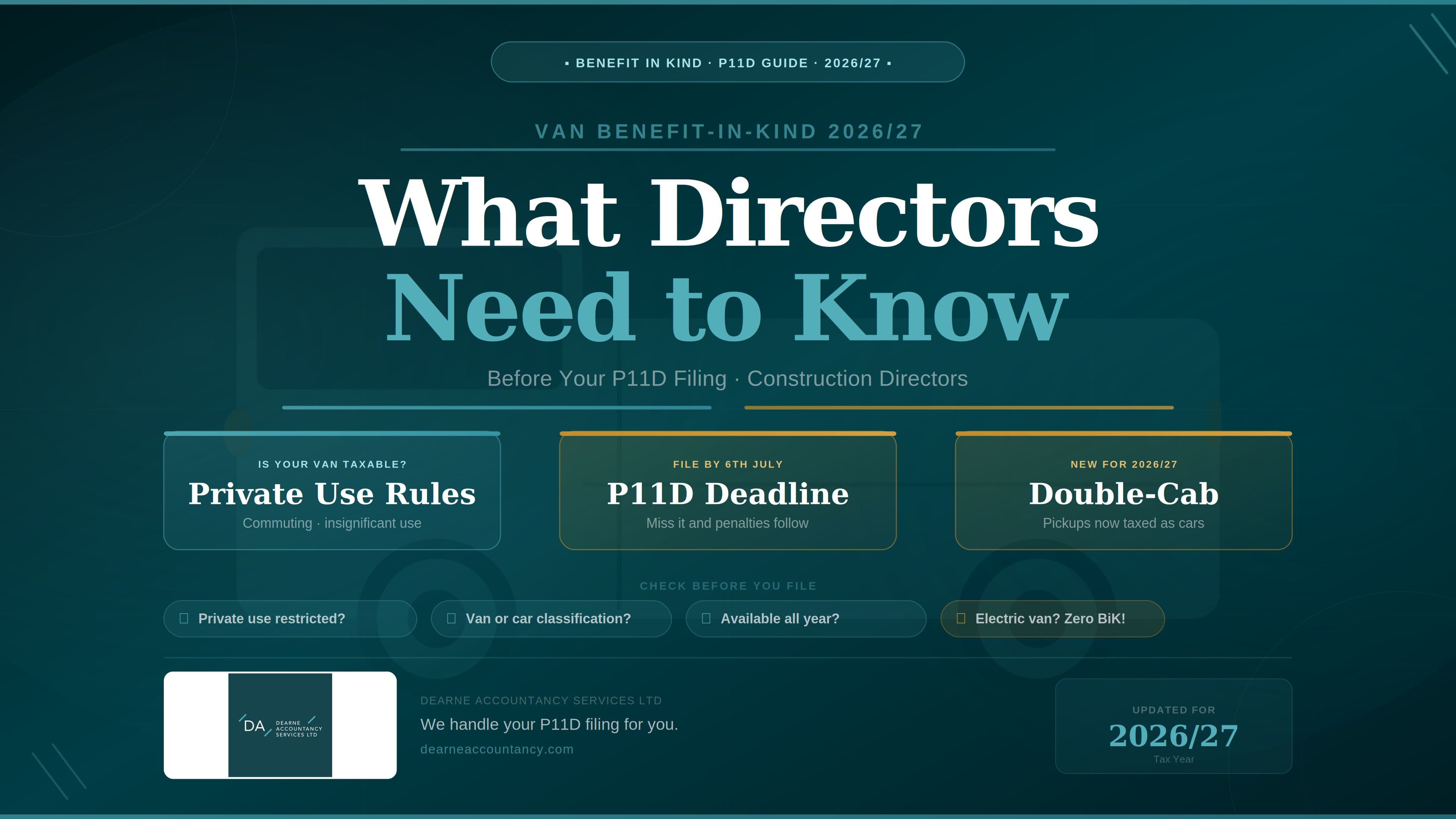
Most construction Ltd directors with a panel van pay no van BIK at all — ordinary commuting and insignificant private use are explicit exceptions. If private use is more than insignificant, the 2026/27 charge is £4,170 van BIK plus £798 fuel BIK. The single biggest change for 2026/27: most double-cab pickups (Ranger, Hilux, Amarok) are now classified as cars for BIK, not vans, with limited transitional relief for vehicles bought before 6 April 2025.
When does a van trigger a BIK?
The thing most directors miss is that the van benefit charge isn’t automatic just because the company owns the van. The legislation is built around an exception called the restricted private use condition. Meet it, and there’s no BIK at all. Two parts to it.
Ordinary commuting doesn’t count
Section 155(5) of ITEPA 2003 — and HMRC’s manual at EIM22800 — explicitly allows the van to be used for "ordinary commuting or travel between two places that is for practical purposes substantially ordinary commuting" without triggering a BIK. Translation: if you drive the company van from your house to the yard, to the site, and back home, you’re inside the exception. The rule was carved out specifically for vans.
Insignificant private use doesn’t count either
HMRC’s worked example for "insignificant" use is "making a slight detour to pick up a newspaper on the way to work" (EIM22745). Stopping at Asda after the last site visit, taking the van to the tip on a Saturday, dropping the kids at school once when the car’s at the garage — all routinely accepted.
Where the line actually sits
What HMRC will challenge is regular, predictable private use. Loading the family in for a weekend away. Running the partner around in it for the school run every day. Letting your son borrow it for his first year at uni. The test isn’t a mileage rule — it’s whether private use is too small or unimportant to be worth consideration. If it’s not, the BIK kicks in for the whole year, not pro-rated.
In my experience most genuine construction-trade vans pass. Where I see problems is when there’s no second household car — the van quietly becomes the family vehicle and the test fails.
When the BIK does bite — the 2026/27 figures
| Charge | 2026/27 value |
|---|---|
| Van benefit (flat rate) | £4,170 |
| Van fuel benefit (only if company pays private fuel) | £798 |
| Employer Class 1A NIC on the benefit | 15% of the BIK value |
| Zero-emission van — both van and fuel | £0 |
Worked example. A 40% taxpayer director with a company van used for private journeys beyond commuting and insignificant use:
- Income tax on the van: £4,170 × 40% = £1,668
- Income tax on fuel (if applicable): £798 × 40% = £319
- Class 1A NIC paid by the company: (£4,170 + £798) × 15% = £745
Combined cost to the director and the company: roughly £2,732 a year for a van the director already uses mostly for work. The fuel charge usually isn’t worth it — most directors pay private fuel personally and avoid the £798 + Class 1A on it entirely.
Double-cab pickups — the biggest change for 2026/27
HMRC reclassified the tax treatment of double-cab pickups from 6 April 2025 (for BIK and Income Tax) and 1 April 2025 (for Corporation Tax). The new test is construction, not usage: if the vehicle is equally suited to carrying passengers and goods — which most DCPUs with a second row of seats are — it’s a car for tax purposes.
This matters because the car BIK runs off a percentage of the vehicle’s list price (P11D value), weighted by CO₂ emissions. For a £55,000 Ford Ranger emitting 220 g/km of CO₂ (top 37% BIK band), the 2026/27 charge would be £55,000 × 37% = £20,350 — versus £4,170 if it were still a van. A 40% taxpayer is looking at £8,140 of personal tax, not £1,668. And there’s no insignificant-use carve-out for cars.
Transitional relief. If you bought, leased, or ordered the DCPU before 6 April 2025, you can continue to treat it as a van until the earlier of:
- the vehicle is disposed of, or
- the lease expires, or
- 5 April 2029.
That last date is the time bomb. If you bought a Ranger in 2024 and you’re planning to keep it past 2029, you’ll get re-categorised as a car at the cliff regardless. Worth modelling now — including whether it makes sense to dispose and replace with a clearly compliant van (panel-only, no rear seats) before 5 April 2029. If your Ltd is running a DCPU and your accountant is still treating it as a van on your post-April-2025 P11D, stop reading this and ring them.
Source: HMRC EIM23151 — Car benefit: double cab pickups 6 April 2025 onwards.
Zero-emission vans — nil charge continues
Both the £4,170 van benefit and the £798 fuel benefit are charged at nil for fully electric vans, and Class 1A NIC on the benefit is also nil. The policy has been in place since 6 April 2021 and continues through 2026/27.
For a director who genuinely uses the van for more than insignificant private use, switching to a zero-emission model saves the full £2,732/year illustrated above. The capital cost has to make sense — but for high-mileage trades the running economics usually do.
Buy personal vs through the company
The short framework:
- Through the company: input VAT recovery on the purchase (if VAT-registered), capital allowances claim (full annual investment allowance up to £1m), running costs deductible against Corporation Tax. BIK only if private use exceeds the exception above.
- Personal: no BIK at all. Claim 45p per business mile up to 10,000 miles, 25p above, reimbursed by the company.
If you genuinely tick the restricted private use test, through the company wins every time — the VAT, capital allowances and CT relief beat the personal mileage rate. If you’re going to fail the test (running it as a family vehicle), personal is usually cleaner. The middle case worth modelling: 20,000 business miles a year and a passable private-use exception → through the company is enormously favourable; 5,000 business miles and the van is the de facto second car → personal is often better despite losing the input VAT.
Get your P11D right by 6 July
The annual P11D deadline is 6 July following the tax year. For benefits arising in 2025/26 (6 April 2025 to 5 April 2026), the P11D is due by 6 July 2026. The same three mistakes turn up every year:
- Treating a DCPU as a van post-6 April 2025 (or post-2029 if you bought before then).
- Failing to file at all because "the van’s purely business" — without the formal restricted-use terms in writing to back it up. If HMRC enquires, no documented restriction = full BIK from year one.
- Including the fuel charge unnecessarily. Only £798 applies if the company actually pays for private fuel. If the director pays personally, the charge is nil.
If you want a second pair of eyes on your P11D before 6 July, we run a P11D health check for new construction Ltd contacts. Our payroll service handles the filing as standard for clients. Get in touch.
Frequently asked questions
Does ordinary commuting in a company van trigger a BIK?
No. Ordinary commuting between home and your usual workplace is explicitly permitted under the restricted private use condition (s.155(5) ITEPA 2003 / HMRC manual EIM22800). It doesn’t count as private use for van BIK purposes.
What is the 2026/27 van benefit-in-kind figure?
£4,170 for the van itself, plus £798 for fuel if the company pays for private fuel. Both are nil for fully electric vans. Employer Class 1A NIC at 15% applies on top.
I drive a Ford Ranger — is it still treated as a van for BIK?
Only if you bought, leased or ordered it before 6 April 2025 — and only until you dispose of it, the lease ends, or 5 April 2029, whichever comes first. From 6 April 2025 onwards, new DCPU acquisitions are treated as cars and taxed on CO₂-based BIK against the list price.
Are zero-emission vans BIK-free?
Yes. Both the van benefit charge and the van fuel benefit charge have been nil for fully electric vans since 6 April 2021 and continue at nil through 2026/27.
When is the P11D deadline?
6 July following the end of the tax year. For benefits in 2025/26 (6 April 2025 to 5 April 2026), the P11D is due by 6 July 2026.